
What is boiler thermostat and sensor repair?
Boiler thermostat and sensor repair fixes the devices that tell a gas boiler when to fire, how hot to run and when to stop. That includes the room thermostat on your wall, the cylinder thermostat, and the temperature sensors and overheat thermostat inside the boiler. When one misreads, the heating either never stops, never starts, or keeps shutting itself down.
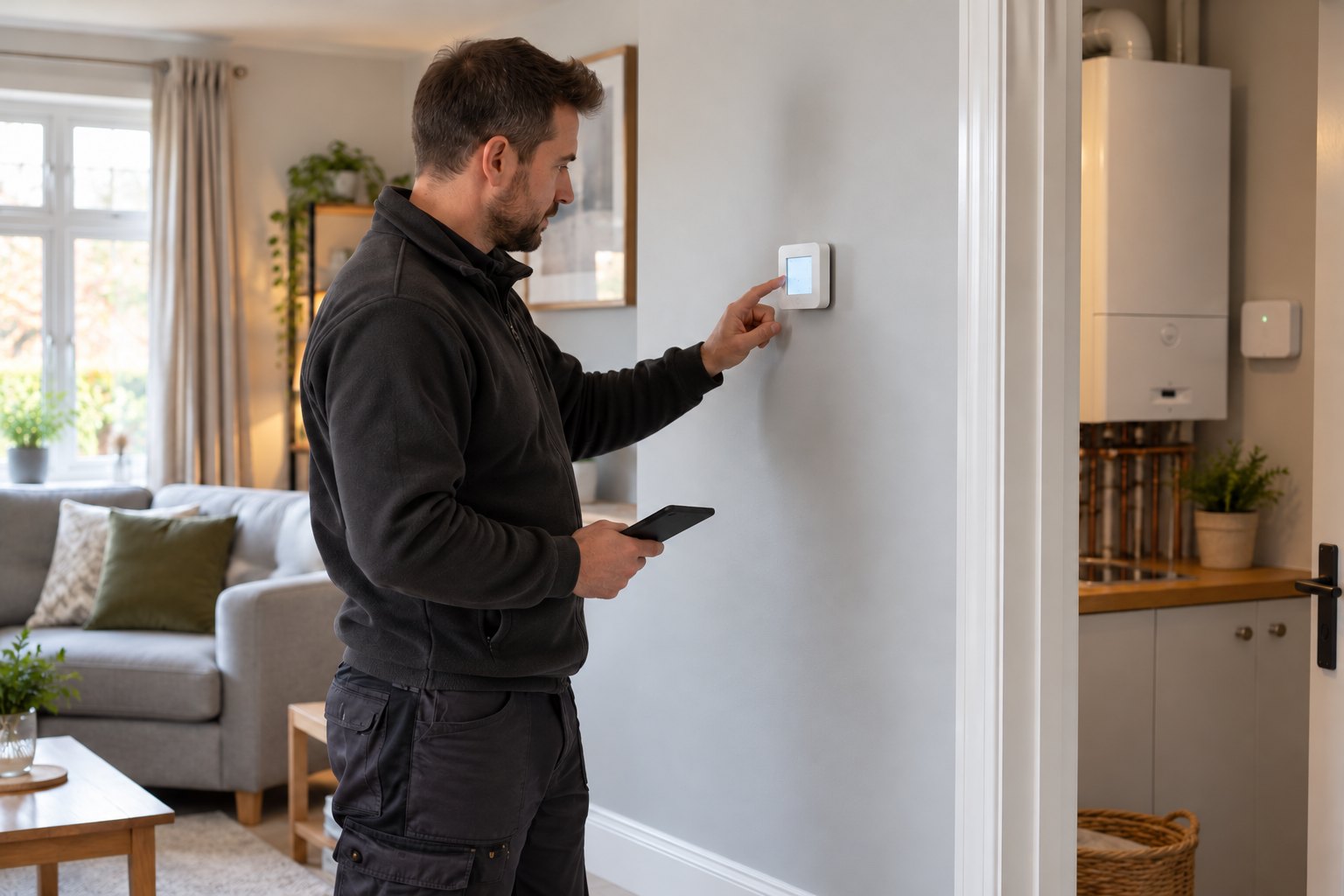
Most of these parts are inexpensive, but finding which one has failed takes testing. A Gas Safe registered engineer will measure the sensors, check the wiring and controls, and replace only the part that is at fault.
Signs you need boiler thermostat and sensor repair
- The house never reaches the temperature set on the thermostat
- The boiler keeps running after the rooms are warm
- The boiler switches on and off every few minutes
- A fault code points to a flow, return or hot water sensor
- The boiler trips on overheat and needs resetting
- A wireless thermostat shows nothing, or the receiver has no light
Thermostat and sensor faults explained
- Room thermostat faults. A dead battery, a drifting sensor or a loose wire can leave the boiler waiting for a signal. Replacing the battery or the thermostat is the cheapest fix.
- Wireless receiver and signal faults. The thermostat may be fine while the receiver next to the boiler has lost its pairing or failed. Re-pairing or replacing the receiver is the cure.
- Boiler temperature sensors. The thermistors that read flow, return and hot water temperature drift or fail. A wrong reading makes the boiler think the water is hotter or colder than it is.
- Overheat thermostat. This safety device trips if the water gets too hot. It can fail, but it more often trips because something else is wrong, so the cause must be found.
- Cylinder thermostat. On systems with a hot water cylinder, a faulty cylinder thermostat can stop the water heating or let it overheat while the radiators work normally.
What to include when asking for a quote
Tell the engineer what the heating does compared with what you asked for. “It never gets warm” and “it never switches off” point in opposite directions, while rapid on-off cycling points to a different sensor or a badly placed thermostat. Say what temperature you set and what the room reaches.
Say where the room thermostat is and whether it is wired or wireless. Add whether the batteries are new and when the boiler was last serviced. A thermostat fixed to a cold external wall or placed above a radiator gives false readings that no replacement part will cure.
Ask the quote to name the part, whether it is a sensor, overheat thermostat, cylinder thermostat or room unit, and whether testing with a meter is included. Ask whether a smart thermostat upgrade is optional, and how the price changes if the wiring is found to be at fault.
How much does boiler thermostat and sensor repair cost?
| Type of job | Typical cost |
|---|---|
| Batteries, reset, or room thermostat replaced | £80–£140 |
| Boiler temperature sensor or cylinder thermostat fitted | £140–£220 |
| Overheat thermostat, or wireless receiver and thermostat set | £220–£300+ |
These are indicative UK budgeting figures, not fixed quotes. Confirm parts, labour, VAT and any call-out charge with the business before booking.
A smart thermostat upgrade is priced separately from the repair. If your boiler sensors are failing, a smart control will not fix it, so get the fault repaired first.
The process: what to expect
- Compare setting and reality. The engineer checks what the thermostat says against the room temperature and the boiler’s behaviour.
- Test the controls. Batteries, wiring and any wireless receiver are checked, with the controls bypassed to see if the boiler responds.
- Measure the sensors. With the casing off, the boiler’s thermistors and overheat thermostat are tested with a meter against the manufacturer’s values.
- Replace the part. The faulty thermostat or sensor is changed, with the wiring and connections checked.
- Run a full cycle. The boiler is taken through heating and hot water cycles to confirm it fires, modulates and stops correctly.
Planning permission and building regulations
Use an engineer on the Gas Safe Register with the right appliance and fuel categories for gas work. Ask to see the attending engineer’s photo ID and check their qualifications. Do not remove the boiler casing yourself. An external pump or room control may need a competent heating or electrical specialist without involving gas work; the qualifications needed depend on what is being disturbed.
A straightforward like-for-like component repair is not normally notifiable under Building Regulations. If the job expands to a replacement boiler, changed flue or new electrical circuit, ask what approvals and certificates are required in your part of the UK.
How to choose an engineer for boiler thermostat and sensor repair
- Is the engineer Gas Safe registered if the repair means opening the boiler?
- Do they test sensors with a meter instead of swapping parts to see?
- Will they check the thermostat position and wiring as well as the part?
- Do they offer a like-for-like part first, with a smart upgrade as an option?
- How long are the part and labour guaranteed?
Frequently asked questions
Why does my boiler overheat?
Causes include a failed temperature sensor, a stuck pump, trapped air, sludge or a faulty thermostat. An overheating boiler should be turned off and checked by a Gas Safe registered engineer.
Where should a room thermostat be fitted?
Usually in a main living area, away from direct sunlight, draughts and radiators, at about eye level. A poorly placed thermostat gives false readings that no new part will fix.
How do I know my boiler sensor has failed?
A sensor fault code, short cycling or a boiler that overheats or never reaches temperature are common signs. An engineer can test the sensor’s resistance to confirm.
What is the difference between a room thermostat and a boiler thermostat?
The room thermostat measures the air in your home and calls for heat. The boiler thermostat, or sensor, measures the water temperature and controls how hot the boiler runs.