
What is boiler PCB and electrical fault repair?
Boiler PCB and electrical fault repair covers the control electronics of a gas boiler: the circuit board that switches the fan, pump and gas valve, the fuses and connectors around it, and the controls that tell it when to run. When these fail, the boiler can seem dead or behave erratically even though the mechanical parts are fine.
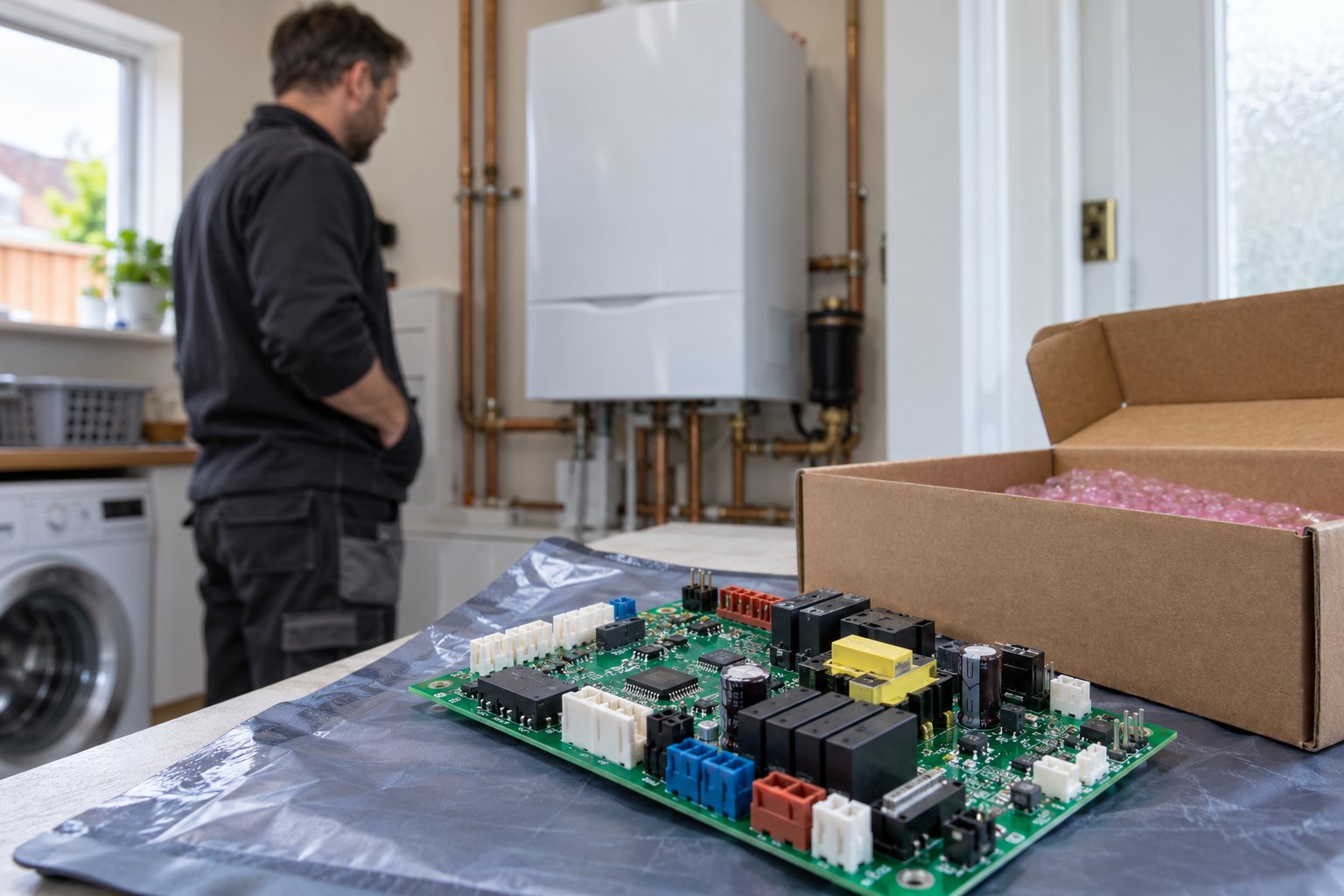
Several faults can look like a failed board. The engineer checks from the supply inwards, ruling out the fuse and controls before recommending a new board. Replacing the right part first time matters, because boards are among the dearest parts in a boiler.
Signs you need boiler PCB and electrical fault repair
- The display is blank or dim, though the fused spur is switched on
- The boiler locks out at random and a power reset clears it for a while
- The fan or pump keeps running after the heating has stopped
- The boiler ignores the thermostat or programmer
- You can smell burning, or see scorch marks near the control panel
- The fuse in the spur blows, or the trip switch goes when the boiler starts
Electrical faults explained
- Supply and fuse faults. A blown fuse, a dead spur or a loose neutral stops everything before it reaches the board. They are cheap to fix, so they are tested first.
- Control faults outside the boiler. A failed programmer, a flat wireless thermostat or a broken receiver can leave the boiler waiting for a call for heat that never comes.
- Main PCB failure. Capacitors, relays and solder joints age with heat cycles. A failed board is replaced with a new or refurbished unit and its settings checked.
- Sensor and wiring faults. A loose or corroded connector, or a damaged wiring loom to the fan, pump or sensors, can look like a board fault but costs less to cure.
- Water damage. A drip from a joint above the boiler can run into the control panel and corrode the board. The leak has to be stopped as well, or the new board will fail too.
What to include when asking for a quote
Tell the engineer exactly what the display shows. “Dead” covers a blank screen, a dim light, flashing codes and a lit panel that ignores the heating, and each points to a different part of the electrical chain. If a fault code appears, copy it down with any letters.
Say what the house did just before the fault: a power cut, a storm, a leak above the boiler or recent electrical work. A sudden failure after a surge points to the board, while an intermittent fault that has crept up over months often points at a connector or a failing relay.
A written quote should say how the board will be sourced and guaranteed, whether testing the controls first is included, and whether a minimum call-out charge applies if the board turns out to be sound. Ask for the board part number so you can compare like for like.
How much does boiler PCB and electrical fault repair cost?
| Type of job | Typical cost |
|---|---|
| Fuse, connector or control fault found and fixed | £150–£220 |
| Main PCB replaced on a common boiler model | £220–£380 |
| PCB for a premium or older model, with extra wiring or sensor work | £380–£500+ |
These are indicative UK budgeting figures, not fixed quotes. Confirm parts, labour, VAT and any call-out charge with the business before booking.
Boards for some makes cost more than this range on their own. If the quote is a large share of the price of a new boiler, ask the engineer about the boiler’s age and how likely other parts are to fail soon.
The process: what to expect
- Test the supply. The engineer checks the socket or spur, the fuse and the earth, and whether power reaches the boiler.
- Check the controls. The programmer, room thermostat or smart control and its wiring are tested or bypassed to see if the boiler responds.
- Inspect and measure. With the casing off, the board, connectors and loom are checked for damage and the outputs measured with a meter.
- Replace the part. The board or faulty part is changed, parameters are set to match the boiler and any leak above it is dealt with.
- Run the boiler. Several heating and hot water cycles are run to confirm the fan, pump, ignition and sensors behave.
Planning permission and building regulations
Use an engineer on the Gas Safe Register with the right appliance and fuel categories for gas work. Ask to see the attending engineer’s photo ID and check their qualifications. Do not remove the boiler casing yourself. An external pump or room control may need a competent heating or electrical specialist without involving gas work; the qualifications needed depend on what is being disturbed.
A straightforward like-for-like component repair is not normally notifiable under Building Regulations. If the job expands to a replacement boiler, changed flue or new electrical circuit, ask what approvals and certificates are required in your part of the UK.
How to choose an engineer for boiler PCB and electrical fault repair
- Is the engineer Gas Safe registered and confident working on the electrics of your make?
- Will they test the supply and controls before ordering a board?
- Is the board new, refurbished or a manufacturer part, and how long is the warranty?
- Do they set the board’s parameters and test the boiler, not just plug it in?
- What happens to the price if the board turns out to be fine?
Frequently asked questions
Why is my boiler display blank?
Possible causes are a blown fuse, a switched-off spur, a faulty board or a failed display. Check only the ordinary user controls described in the manual. Do not keep resetting a tripping circuit or replacing fuses; arrange a qualified engineer.
How much does a boiler PCB cost?
The part alone can range from around £100 to £400 or more depending on the make, with labour on top. Ask for the part and labour shown separately.
Can a boiler PCB be repaired instead of replaced?
Some specialist firms repair or refurbish boards. Engineers more commonly fit a new or refurbished unit with a guarantee, because repairs on site are not practical.
Will a new board fix intermittent faults?
Often, if the board was the cause. But a fault that comes and goes can also be a loose connector, a failing sensor or a damp joint above the boiler, so ask the engineer how they proved it was the board.