
What is boiler pressure repair?
Boiler pressure repair puts right a sealed central heating system that cannot hold its pressure, or whose pressure climbs too high. The gauge on the front of the boiler shows the water pressure in the sealed heating circuit, and when it falls too low most boilers shut down to protect the heat exchanger.
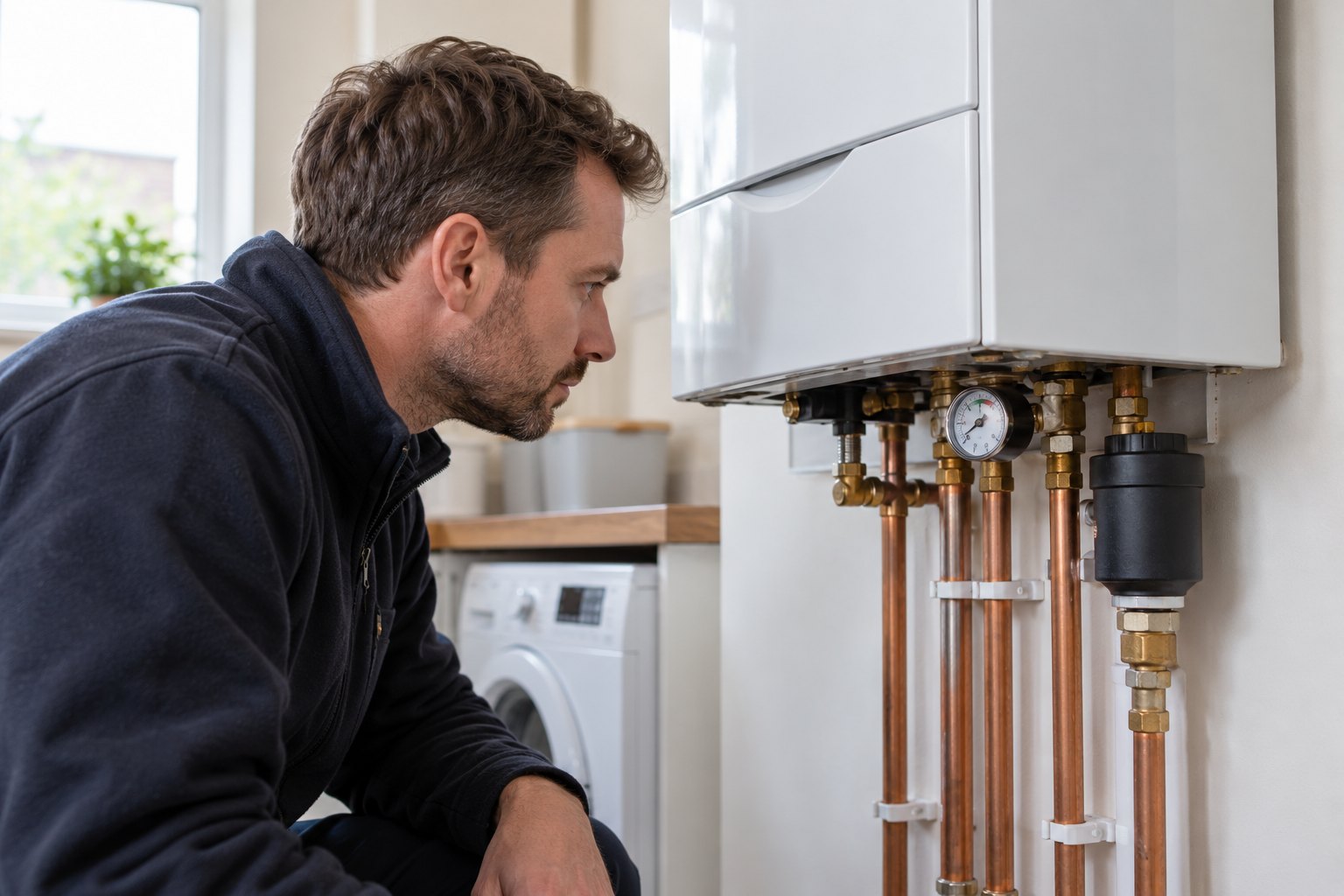
Fixing it means finding where the water goes, or why the system cannot absorb the expansion as it heats. A Gas Safe registered engineer will usually check the filling loop, the expansion vessel, the pressure relief valve and the pipework before suggesting any part.
Signs you need boiler pressure repair
- The boiler shows a low-pressure fault code or locks out until you top it up
- The gauge needle drops towards zero within days of being repressurised
- The pressure rises beyond 2.5 bar when the heating warms up
- Water drips from the copper pressure relief pipe outside the house
- You top up the filling loop every few weeks, and radiators need bleeding more than they used to
- A damp patch appears below a radiator, under a floor or around the boiler cupboard
Pressure repair options explained
- Filling loop and gauge check. The braided hose that tops the system up from the mains is checked for a weeping seal or a valve left slightly open, and the gauge is tested against a known reading.
- Expansion vessel recharge or replacement. The vessel’s rubber diaphragm separates the water from a cushion of air. If the air has leaked out, pressure spikes as the water heats. Recharging with a pump is quick, but a split diaphragm needs a new vessel.
- Pressure relief valve replacement. A valve that has opened once can fail to reseat and keep weeping. It is a small part, but the system has to be partly drained to fit it.
- Leak tracing and repair. A pressure test, a moisture meter or a thermal camera finds the escape, and the joint, valve or radiator is repaired. Hidden leaks under floors add access work.
- Pressure sensor or gauge fault. On some boilers the gauge or electronic sensor reads wrongly, so the boiler locks out even though the system is full. Testing against a separate gauge settles it.
What to include when asking for a quote
Describe the needle, not just the word “pressure”. Say what it reads cold, what it reads once the radiators are hot, and how many days a top-up lasts. A system that falls from 1.2 bar to 0.3 bar over a week is a different job from one that spikes to 3 bar every morning and spits water out of the discharge pipe.
Say where the discharge pipe ends, whether the ceilings or floors near radiators show stains, and whether any radiator, valve or pipe has been replaced recently. Tell the engineer if the pipes run under boarded floors, because leak tracing there costs more time than in a house with pipes in plain view.
The written quote should say whether leak tracing and a pressure test are included or charged by the hour, which part is being priced if it is a vessel or valve, and whether the system will be topped up, inhibitor added and the radiators bled afterwards. Ask how long the engineer will watch the gauge before leaving.
How much does boiler pressure repair cost?
| Type of job | Typical cost |
|---|---|
| Pressure check, filling loop fault or small top-up fix | £90–£140 |
| Expansion vessel recharge or pressure relief valve replaced | £140–£230 |
| Leak tracing, vessel replacement or hidden pipe repair | £230–£350+ |
These are indicative UK budgeting figures, not fixed quotes. Confirm parts, labour, VAT and any call-out charge with the business before booking.
A leak that sits under screed or behind tiles can cost far more once the floor or wall is opened up and made good. That finishing work is usually priced separately from the heating engineer’s fee.
The process: what to expect
- Read the gauge. The engineer notes the cold and hot readings, checks the filling loop is closed, and looks at the discharge pipe.
- Look for the loss. Joints, valves, radiators, the boiler’s internal connections and the pipe run are checked for weeping water, sometimes with a pressure test.
- Test the vessel. With the boiler isolated and the vessel drained, the air charge is checked at the valve on the vessel.
- Fix and refill. The engineer recharges or replaces the failed part, repairs the leak, and repressurises the system to the figure in the manual.
- Watch it settle. The system is heated, the radiators vented, and the gauge is checked again so you know the pressure holds.
Planning permission and building regulations
Use an engineer on the Gas Safe Register with the right appliance and fuel categories for gas work. Ask to see the attending engineer’s photo ID and check their qualifications. Do not remove the boiler casing yourself. An external pump or room control may need a competent heating or electrical specialist without involving gas work; the qualifications needed depend on what is being disturbed.
A straightforward like-for-like component repair is not normally notifiable under Building Regulations. If the job expands to a replacement boiler, changed flue or new electrical circuit, ask what approvals and certificates are required in your part of the UK.
How to choose an engineer for boiler pressure repair
- Do they carry a pressure gauge and a pump to test the vessel on the day?
- Will they pressure test the system, or just top it up and leave?
- Is leak tracing included in the quote, or charged by the hour?
- Will they tell you in writing where the water was lost and what they replaced?
- Who makes good any boards or plaster opened to reach a hidden leak?
Frequently asked questions
What should my boiler pressure be?
Most sealed systems sit at roughly 1 to 1.5 bar when cold and rise towards 2 to 2.5 bar when hot. Check the manual for your make before topping up.
Is high boiler pressure dangerous?
Pressure that creeps above 2.5 or 3 bar is approaching the point where the relief valve opens. The valve is designed to release water safely, but repeated discharge means something is wrong. Switch the heating off and have an engineer look at it.
Can I keep topping up instead of repairing it?
Occasional top-ups are normal, but a system that needs frequent top-ups has a leak or a failed part. Fresh water also brings in more air and oxygen, which speeds up corrosion, so the cause is worth fixing.
Will low pressure damage my boiler?
Running a boiler with repeatedly low pressure can overheat its heat exchanger, which is why most boilers lock out. Resetting it again and again is not a fix.