
What is boiler diverter valve repair?
Boiler diverter valve repair restores the valve that routes heated primary water in a combi boiler towards the radiators or the hot-water heat exchanger. A system boiler with a separate cylinder may use external motorised valves instead, so the arrangement needs checking. When it sticks, leaks or loses its motor, the house ends up with heating but no hot water, or with radiators that warm up every time someone washes their hands.
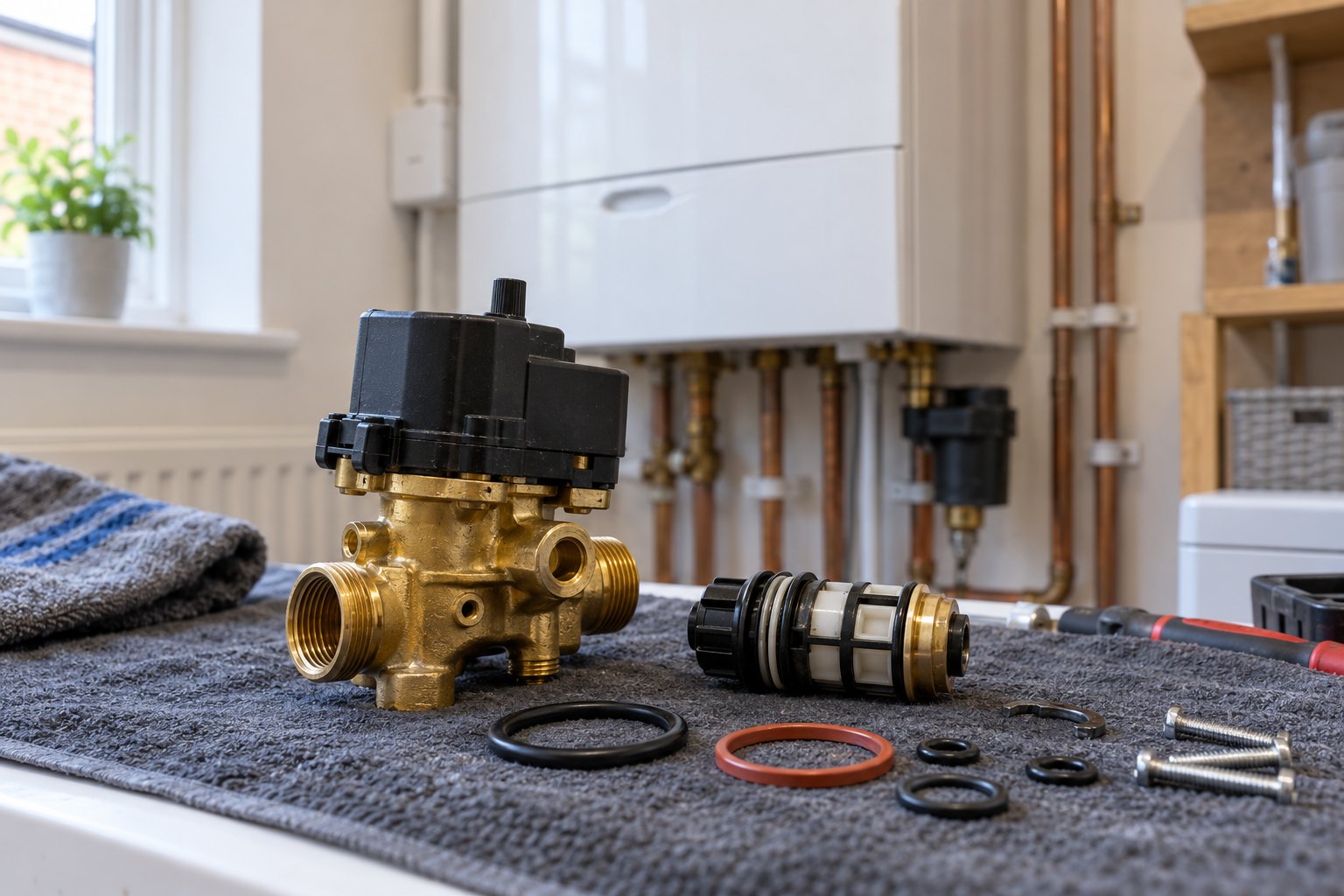
The valve is a modest part, but it sits deep inside the boiler, so a Gas Safe registered engineer has to isolate and partly drain the boiler to reach it. Knowing whether the motor, cartridge or whole valve is at fault keeps the repair price down.
Signs you need boiler diverter valve repair
- The radiators are hot but a hot tap only runs cold or lukewarm
- The radiators warm up whenever a hot tap is opened
- Hot water begins well, then fades to lukewarm within a minute
- The boiler clunks, bangs or vibrates when it switches between heating and hot water
- Water weeps from the valve or from underneath the boiler
- The valve motor hums or clicks but the valve does not move
Diverter valve repair options explained
- Actuator or motor head replacement. If the motor that moves the valve has failed, only the actuator is replaced. It is often a plug-in part and the cheapest repair.
- Cartridge or shuttle replacement. In hydraulic types, a worn cartridge lets water pass the wrong way. A new cartridge and seals restore the seal without a new body.
- O-ring and seal replacement. Weeping from the valve is often an O-ring. Replacing the seals is a small repair, but only if the body is not cracked or scored.
- Full valve body or hydraulic block. If the body is cracked, scaled or the ports are damaged, the whole valve or the hydraulic assembly is fitted, which costs more.
- Cleaning and descaling. In hard water areas, debris and scale stop the valve seating. Cleaning can restore it, though it may be a short-term fix on an old valve.
What to include when asking for a quote
Tell the engineer the order of events. Does the hot tap run cold from the start, or start hot and fade? Do the radiators warm while a tap runs? Do you hear the valve click or hum? Those clues separate a stuck valve from a failed motor and from a scaled heat exchanger.
Give the boiler make, model and age and say if you can see drips under it. Some makes have valves that come as a single assembly, while others allow cartridge swaps, and the difference can change the price by well over £100. A photo of the data badge lets the engineer check the part before the visit.
Ask for a quote that lists the actual part, whether it is the actuator, cartridge, seals or full valve, and the labour for draining, refilling and bleeding the boiler. Ask whether the engineer carries the part, and what a second visit would cost if it has to be ordered.
How much does boiler diverter valve repair cost?
| Type of job | Typical cost |
|---|---|
| Actuator or motor head replaced, or valve cleaned and re-seated | £180–£250 |
| New cartridge, seals or valve kit fitted | £250–£350 |
| Full valve body or hydraulic assembly replaced | £350–£450+ |
These are indicative UK budgeting figures, not fixed quotes. Confirm parts, labour, VAT and any call-out charge with the business before booking.
Part prices differ a lot between makes. A hydraulic assembly on some boilers is a large share of the repair price, so ask the engineer about cheaper options as well as the manufacturer’s complete unit.
The process: what to expect
- Test the symptoms. The engineer runs a hot tap and the heating, watches which circuits respond and listens for the valve.
- Check the motor. With the casing off, they see whether the actuator moves the valve and measure the power supply to it.
- Remove the valve. The boiler is isolated and partly drained so the valve or its cartridge can be taken out.
- Fit the repair. New seals, a cartridge, an actuator or the valve body are fitted and the boiler reassembled.
- Refill and test. The boiler is repressurised and bled, then both hot water and heating are tested separately and together.
Planning permission and building regulations
Use an engineer on the Gas Safe Register with the right appliance and fuel categories for gas work. Ask to see the attending engineer’s photo ID and check their qualifications. Do not remove the boiler casing yourself. An external pump or room control may need a competent heating or electrical specialist without involving gas work; the qualifications needed depend on what is being disturbed.
A straightforward like-for-like component repair is not normally notifiable under Building Regulations. If the job expands to a replacement boiler, changed flue or new electrical circuit, ask what approvals and certificates are required in your part of the UK.
How to choose an engineer for boiler diverter valve repair
- Is the engineer Gas Safe registered for domestic gas boilers?
- Have they replaced diverter valves on your make before?
- Will they say whether the motor, cartridge or full valve is the cause?
- Do they carry common diverter parts, or will they have to order?
- How long are the part and labour guaranteed?
Frequently asked questions
What happens if my diverter valve fails?
The boiler may be unable to switch between heating and hot water. Typically hot water fails while the heating works, or the radiators heat when a tap runs. An engineer should assess the fault, especially if there are leaks or overheating.
How long does a diverter valve last?
Often 8 to 12 years, though hard water and system debris can shorten it. A magnetic filter and regular servicing help.
Can I tell which part of the diverter valve has failed?
Not reliably without opening the boiler. An engineer can check the motor with a meter and the valve by hand, which tells them whether the motor, cartridge or body needs replacing.
Do I need to drain the whole heating system?
Usually only the boiler or part of it, because the valve sits inside the boiler. The engineer will isolate the boiler first, then refill and bleed the system afterwards.